|
A Ripper Notes Article
|
 This article originally appeared in Ripper Notes. Ripper Notes is the only American Ripper periodical available on the market, and has quickly grown into one of the more substantial offerings in the genre. For more information, view our Ripper Notes page. Our thanks to the editor of Ripper Notes for permission to reprint this article.
|
 |
Windows and Witnesses
by Dave Yost
One item of interest in the Annie
Chapman case is the idea that there was no struggle. Those
individuals who either testified at the inquest or spoke with the
press stated that there was no noise heard with Cadoche
describing a very minimal amount of activity. Eyewitnesses and
witness testimonies are probably one of the more complex areas
within an investigation of any crime. The level at which we
accept or reject a witness is based on what we perceive to be the
truth regarding the case. This also transcends into the level at
which we define what the witness is offering us. However, even if
we believe what a witness has stated, this does not necessarily
make the witness, or his/her entire testimony, valuable, nor does
it make that witness's phrasing completely accurate.
On 10 September, John Davis testified at the Chapman inquest:
'I have lodged at 29, Hanbury-street
for a fortnight, and I occupied the top front room on the
third floor...On Friday night I went to bed at eight
o'clock...There is a weaving shed window, or light across the
room. It was not open during the night. I was awake from
three a.m. to five a.m. on Saturday, and then fell asleep
until a quarter to six, when the clock at Spitalfields Church
struck. I had a cup of tea and went downstairs to the back
yard. The house faces Hanbury-street...[Coroner] Did you hear
any noise that Saturday morning? - [Davis] No, sir.' (1)
Davis's testimony might be considered
beneficial because he was either awake or merely dozing during
Annie's murder, and yet, according to the Daily Telegraph's
report, he heard nothing at a time of critical importance with
respect to the murder. But, he and his family lived in the front
room of the attic, (i.e., street side about twenty feet above the
pavement) with the window shut. So, his testimony about hearing
nothing, (or what is sometimes described by authors as, only the
usual early morning street sounds), would be expected. If he had
heard anything from the backyard, then it would have been loud
enough to wake the entire household. This, of course, did not
happen, so On this point, Davis's testimony IS useless. Albeit,
there were other people, nearer the murder scene, who would have
been more readily aware of any such noise. In fact, Mrs
Richardson told the press that 'Several persons sleep at the back
of the house, and some had their windows open, but no noise was
heard from the yard.' (2)
The tenants who occupied the back part
of the house were: Mr. Waker, living in the ground floor back
room with his mentally retarded, adult son; the Copsey sisters,
who lived in the first floor back room; Mrs Cox (described as a
'little old lady') resided in the attic's back room; and,
possibly, Mrs Hardiman, who used the ground floor front room as a
shop and as living quarters. Of the estimated seventeen residents
only these few were close enough to the murder scene to have
possibly heard something, but only some of them had their window
open. It is unknown, at present, which windows were actually
open, but it can be inferred. (3)
Because of her age and because of the
coolness of the evening and morning, (see Table 1), it is
doubtful that Mrs Cox had her window open, and Mrs Hardiman did
not occupy the back part of the house. That leaves only Mr.
Waker's room and the Copsey sisters'. So from here, it can be
estimated that only two windows might have been open at the time
of Annie's death.
Table 1 - Weather Conditions (4)
| Victims |
Date_&_Day |
Hi Temperture (Fahrenheit) |
Lo Temperature (Fahrenheit) |
Amount
of Rain |
Amount of Cloud Cover |
Remarks |
Chapman,
Annie |
7 September,
Friday |
65.9 degrees |
50.8 degrees |
0.02 inches |
70% |
N/A |
8 September,
Saturday |
58.2 degrees |
47.4 degrees |
0.01 inches |
30% |
N/A |
Referring to the photo below, we can see
the steps, upon which John Richardson sat, the fence (&
palings) mentioned by Cadoche, the location of the cellar door,
(which was observed by Richardson for whether or not it was
properly padlocked), and of course the back room, ground floor
window. The window shown corresponds to Mr. Waker's room and
seems to be about four and half to five feet above the backyard
while the Copsey sisters' would have been one floor above, (i.e.,
about ten feet above the scene).
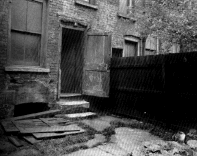
backyard, 29 Hanbury Street
In spite of Mr. Waker's close proximity
to the murder scene (an estimated five to six feet from where
Annie was killed and mutilated) with an open window, even he was
unaware of what had happened till the discovery of the body.
Ostensibly, there was no struggle, and Mrs Richardson adds to
this sentiment, "They [tenants] mostly work at the fish
market or in the Spitalfields Market. Some of the carmen leave
home as early as one a.m., while others go out at four and five,
so that the place is open all night, and any one can get in...if
there had been any struggle it must have been heard..." It
can be safely concluded that Annie did not, at least, scream out,
else Mr. Waker, the Copsey sisters, and possibly Cadoche would
have heard it. But was Annie subdued as quickly as all of this
indicates? Cadoche's testimony seems to describe something a
little different. (5)
'I [Albert Cadoche] live at 27,
Hanbury-street, and am a carpenter. 27 is next door to 29,
Hanbury-street. On Saturday, Sept. 8, I got up about a quarter
past five in the morning, and went into the yard. It was then
about twenty minutes past five, I should think. As I returned
towards the back door I heard a voice say "No" just as
I was going through the door. It was not in our yard, but I
should think it came from the yard of No. 29. I, however, cannot
say on which side it came from. I went indoors, but returned to
the yard about three or four minutes afterwards. While coming
back I heard a sort of a fall against the fence which divides my
yard from that of 29. It seemed as if something touched the fence
suddenly.' (6)
Between c.5:20 and c.5:25, Cadoche heard
two things emanating from the backyard of number 29: the word
"no" and a "sort of fall" against the fence.
Annie died around 5:30 that morning and it seems reasonable that
she and her killer might have been in the backyard for a short
time prior the attack. Therefore, we can safely estimate that
Cadoche heard Annie say, "No", then a few minutes
later, he heard her or her killer "fall" against the
fence. This does indeed indicate that some sort of struggle had
taken place.
Often enough, we are directed by the use
of certain words or by how the information is phrased, which can
sometimes lead us to erroneous conclusions. Regretfully, the very
nature of the word "struggle" infers that Annie had
fought back, ("to make strenuous or violent efforts against
opposition"). In this particular case, its use would
actually refer to the notion that Annie's killer was not able to
instantly subdue her. (7)
Notes: The
press were not always correct or consistent with how names of
witnesses were spelled, sometimes spelling them based on how they
sounded. The following are some variations which might be
typically found: John Davis (Davies) Mr Waker (Walker) the Copsey
sisters (Mr and Mrs Huxley) Albert Cadoche (Cadosch, Cadosh) Mrs
Hardiman (Hardyman, Hardman with a first name of Annie, Harriet,
or Mary)
References
1) Daily Telegraph, 11 September, 1888, page 3,
(according to A-Z, 2nd ed, page 104, Davis was awake at c.5:30
A.M., which is the estimated time of Annie's death)
2) Daily Telegraph, 10 September, 1888, page 3
3) Daily Telegraph, 13 September, 1888, page 3; The
Complete History of Jack the Ripper, pages 82-83
4) Unofficial weather reports for Whitechapel as recorded at St
Luke's by the Royal Meterological Society for September 1888
5) Daily Telegraph, 10 September, 1888, page 3
6) Daily Telegraph, 20 September, 1888, page 2
7) "struggle" as defined by Webster's Ninth New
Collegiate Dictionary, page 1170
