Illustrated Police News
17 November, 1888
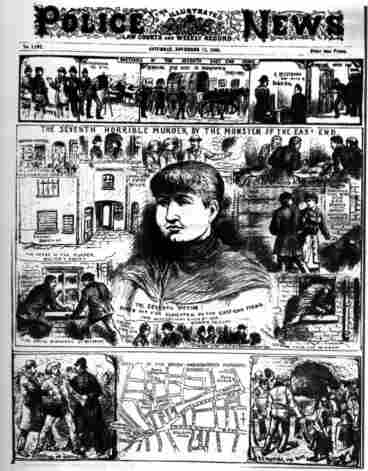
ANOTHER WHITECHAPEL HORROR.
MORE REVOLTING MUTILATION THAN EVER.
[WITH FULL PAGE ILLUSTRATIONS.]
ON Friday another addition was made to the series of horrible
crimes that has created a panic in the East End of London for
many weeks past, and has sent a thrill of horror through the
country at large. As in the previous cases, the scene of the
tragedy lies in the district of Whitechapel, within almost a
stone's throw of Hanbury-street, where the unfortunate woman
Nicholls (sic) was so brutally put to death. The victim
was another of the unfortunate class, who occupied a miserably-
furnished room in a court off Dorset-street, a narrow
thoroughfare out of Commercial-street, not far removed from
the police-station. She had lived in the court for some little
time, and was known as Mary Jane Kelly, alias "Ginger." She
was a Welsh woman, and it is believed was married, but separated
from her husband. Recently she had lived with a man who was
known in the neighbourhood as Dan, but the couple parted a few
days ago. Since that time the murdered woman had been seen
several times walking about the locality, and on more than one
occasion has been in the company of men. It is supposed that
she met the man who was to be her murderer at a late hour on
Thursday night, and that he induced her to allow him to accompany
her home. Though there is good reason to believe that the
murderer was in the house the whole of the night, he did not
carry out his terrible purpose until a period later than half-
past eight o'clock on Friday morning. At that time the deceased
was seen walking along Dorset-street, and it is supposed that
she had left the house for the purpose of purchasing breakfast.
She is then said to have appeared cheerful and looking bright
and well. Some two hours from this time the unfortunate woman
was found lying dead and frightfully mutilated. At half-past
eleven o'clock a man went to the room to collect the rent, and
failing to gain any answer to his knocking at the door, he looked
through the window. It was then seen that the woman was lying
naked and bleeding on the bed, and an alarm was at once given.
A policeman was summoned, and he at once took possession of
the room, and refused to allow anyone to enter until a medical
man had been brought to the spot. When this had been done, a
scene more terrible than any of the others that have preceded
it was disclosed. Such a shocking state of things was there
as has probably never been equalled in the annals of crime.
The throat had been cut right across with a knife, nearly
severing the head from the body. The abdomen had been ripped
partially open, and both of the breasts had been cut from the
body. The left arm, like the head, hung to the body by the
skin only. The nose had been cut off, the forehead skinned,
and the thighs, down to the feet, stripped of the flesh. The
abdomen had been slashed with a knife across and downwards,
and the liver and entrails wrenched away. The entrails and
other portions of the frame were missing, but the liver, etc.,
it is said, were found placed between the feet of the poor
victim. The flesh from the thighs and legs, together with the
breasts and nose, had been placed by the murderer on the table,
and one of the hands of the dead woman had been pushed into
her stomach.
Inspector Beck took charge of the case, and, having sent out
all the constables that could be spared to make inquiries, he
repaired to Dorset-street, where he established a kind of
blockade at Miller's-court, refusing either egress or ingress
to the inhabitants. The traffic in Dorset-street was also
regulated, and the immense crowds which the news of the murder
had attracted thither were prevented from entering the street.
The refusal of the police to allow any one to enter or to leave
Miller's-court was connected with an intention to put the
bloodhounds on the track of the murderer, and it was feared
that the scent would be seriously interfered with, if not
completely destroyed, if indiscriminate traffic were allowed.
The bloodhounds were asked for immediately the discovery was
made; but they could not be found.
The victim of the monstrous outrage belonged to the very lowest
class. She occupied a cheerless and dismal-looking room on
the ground floor or No. 26, Dorset-street. The entrance to
her room, however, is from the passage between the houses Nos.
26 and 29, leading into Miller's-court. The room, which was
at the back of the house, was very scantily furnished. It
contained little besides a bed, a rickety table and a couple
of chairs. Both Nos. 26 and 28 are in the occupation of a Mrs.
M'Carthy, who carried on the business of a provision dealer
at No. 28. It was the son of the landlady who first discovered
the murder and gave information to the police. The landlady
adheres strictly to the principle of "ready" cash in dealing
with the lodgers. It is usually her practise to wait on them
in the course of the morning, and receive each day's rent in
advance.
Dr. Dukes; Dr. Phillips, of Spital-square; Dr. J. R. Gabe, of
Mecklenburg-square; and Dr. Bond, of Westminster Hospital, all
saw the body, of which a photograph had been taken, shortly
before two o'clock. As it lay on the bed it presented a ghastly
spectacle, and so complete had been the mutilation, that it
was difficult to tell whether it was that of a man or woman.
It lay on its back, with the legs outspread. The face had been
so cut and hacked that the features could not be discerned at
all. The conclusion was arrived at that the woman's throat
had first been cut, causing her instant death, and preventing
the possibility of cries.
The body was placed in a plain coffin and removed, shortly before
four o'clock, to the mortuary in Shoreditch, in a spring van,
followed by a crowd.
REMARKABLE STATEMENT.
A Mrs. Pannier, a young woman who sells roasted chestnuts at
the corner of Widegate street, a narrow thoroughfare, about
two minutes' walk from the scene of the murder, told a reporter
a remarkable story. She says that about twelve o'clock (noon)
on Friday, a man, dressed like a gentleman, came to her and
said, "I suppose you have heard about the murder in
Dorset-street." She replied that she had, and the man grinned
and said, "I know more about it thank you." He then stared
into her face, and went away down Sandes-row, another narrow
thoroughfare which cuts across Widegate-street. When he had
got some way off, however, he looked back as if to see whether
she was watching him, and then vanished. Mrs. Pannier says
that the man had a black moustache, was about five feet six
inches high, and wore a black silk hat, a black coat, and
speckled trousers. He carried a black shiny bag about a foot
in depth, and a feet and a half in length. Mrs. Pannier states
further that the same man accosted three young unfortunates
in Dorset-street on Thursday night, and they chaffed him, and
asked him what he had in the bag, and he replied, "Something
that the ladies don't like." Mrs. Pannier told her story with
every appearance of truthfulness.
Maurice Lewis, a tailor, living in Dorset-street, stated that
he had known the deceased woman for the last five years. Her
name was Mary Jane Kelly. She was short, stout, and dark; and
stood about five feet three inches. He saw her on the previous
(Thursday) night, betwen ten and eleven, at the Horn of Plenty
in Dorset-street. She was drinking with some woman and also
with "Dan," a man selling oranges in Billingsgate and
Spitalfields markets, with whom she lived up till as recently
as a fortnight ago. He knew her as a woman of the town. One
of the woman whom he saw with her was known as Julia. To his
knowledge she went home overnight with a man. He seemed to be
respectably dressed. Whether or no the man remained all night
he could not say. Soon after ten o'clock in the morning he
was playing with others at pitch and toss in M'Carthy's-cour,
when he heard a lad call out "Copper," and he and his companions
rushed away and entered a beer-house at the corner of Dorset-
street, known as Ringer's. He was positive than on going in
he saw Mary Jane Kelly drinking with some other people, but
is not certain whether there was a man amongst them. He went
home to Dorset-street on leaving the house, and about half an
hour afterwards heard that Kelly had been found in her room
murdered. It would then be close upon eleven o'clock.
Dr. J. R. Gabe, of Mecklenburg-square, saw the body, but, in
reply to a question put to him, he declined to give any details.
He merely said that he had never, in all his life, seen such
a horrible sight as the murdered woman presents. In addition
to the mutilations already named, it was afterwards ascertained
that the forehead and even the cheeks were skinned.
THE DISCOVERY OF THE CRIME.
John M'Carthy, who resides at 27, Dorset-street, informed a
reporter that Mary Jane Kelly, the murdered woman, was a person
about twenty-five years of age. She was an unfortunate. The
last that he heard of her was at one o'clock on Friday morning,
when she was singing in her room, and appeared to be very happy.
At eleven o'clock on Thursday night she was seen in the Britannia
public-house, which is situated at the corner of this
thoroughfare, with a young man with a moustache. She was then
intoxicated. The young man appeared to be very respectable
and well dressed. With respect to the discovery of the appalling
crime, M'Carthy said: About half-past ten this (Friday) morning
I saw a man named Henry Bower go to Mary Jane Kelly and asked
for the rent she owed. Bower went to the house, but got no
answer to his knocks. He peered through one of the windows
and saw the woman lying out up on the bed. The bed was saturated
with blood. Bower called me, telling me what he had seen, and
we went and looked through the window. I cannot fully describe
her injuries, for the sight was too much for me. She was quite
naked. I noticed that both breasts were cut off, and that she
was ripped up. The intestines were laid on the table, both
ears were cut off, as was also the nose. The legs of the
deceased were cut to such an extent that the bones could be
seen. Her face was one mass of cuts. We ran to the Commercial-
street Police-station and told them of it. In answer to
questions as to whether the woman was married, M'Carthy said
deceased's husband was a fish porter, employed in Billingsgate,
but in consequence of a quarrel between them four nights ago
the man left her, and went to lodge at Mr. Buller's boarding-
house in Bishopsgate-street.
THE SCENE OF THE MURDER.
Dorset-street, the scene of the murder, runs off Commercial-
street, and is almost opposite St. Stephen's Church,
Spitalfields. It is a narrow thoroughfare, with barely
sufficient room for two vehicles to pass one another. There
are several lodging-houses in the street, and there is hardly
a house that does not give shelter to lodgers, many of whom
come at night and disappear in the morning. The courts leading
out of the street are full of lodging-houses. Miller's-court,
leading at right angles out of Dorset-street, is a miserable
alley, forming a cul de sac. It is known in the locality
as M'Carthy's court, on account of being owned by the keeper
of the chandler's shop. There are three or four houses of the
meanest description, with whitewashed fronts, and approached
by a narrow arched passage, not more than a yard and a half
wide. The surrounding district is very rough. It is in close
vicinity to Spitalfields Market, and within a hundred yards
or so of Toynbee Hall.
The most curious item in the entire surroundings is a large
placard posted on the walls of the next house to one where the
murder was committed offering, in the name of the
ILLUSTRATED POLICE NEWS, a reward of POUNDS 100 for
the discovery of the diabolical assassin. This is shown in
the centre illustrated on our front page together with a plan
of the locality. The precise spot where each crime was committed
is indicated by a dagger and a numeral.
1. Emma Elizabeth Smith, forty-five, stabbed near
Osborne-street, Whitechapel, April 3rd.
2. Martha Tabram, thirty-five, stabbed in thirty-nine places,
at George-yard-buildings, Commercial-street, Spitalfields, August
7th.
3. Mary Ann Nicholls, forty-seven, had her throat cut and body
mutilated, in Buck's-row, Whitechapel, August 31st.
4. Annie Chapman, forty-seven, her throat cut and body
mutilated, in Hanbury-street, Spitalfields, September 8th.
5. Elizabeth Stride, throat cut in Berner-street, Whitechapel,
on Sunday, September 30th.
6. Catherine Eddowes, alias Conway, alias Kelly, mutilated
in Mitre-square, Aldgate, also on September 30th.
7. Mary Jeanette Kelly, mutilated in Miller's-court,
Whitechapel, November 9th.
There was no appearance of a struggle having taken place, and,
although a careful search of the room was made, no knife or
instrument of any kind was found. Dr. Phillips, on his arrival,
carefully examined the body of the dead woman, and later on
again made a second examination in company with Dr. Bond, from
Westminster; Dr. Gordon Brown, from the City; Dr. Duke, from
Spitalfields; and Dr. Phillip's assistant. Mr. Anderson, the
new Commissioner of Police, Detective-Inspectors Reid and
Abberline (Scotland-yard), Chief-Inspector West, H Division,
and other officers were quickly on the spot. After the
examination of the body it was placed in a shell, which was
put into a van and conveyed to the Shoreditch mortuary to await
an inquest.
From inquiries made among the persons living in the house
adjoining the court, and also those residing in rooms in No.
26, it appears clear that no noise of any kind was heard. No
suspicious or strange-looking man was seen to enter or leave
the murdered woman's room, and up to the present time the
occurrence is enveloped in as much mystery as were the previous
murders. The man Kelly was quickly found, and his statement
ascertained to be correct. After the examination the windows
were boarded up and the door padlocked by direction of the
police, who had considerable difficulty in keeping the street
clear.
WHEN THE WOMAN WAS LAST SEEN ALIVE.
Another account says that she had a little boy, aged about six
or seven years, living with her, and latterly she had been in
narrow straits, so much so that she is reported to have stated
to a companion that she would make away with herself, as she
could not bear to see her boy starving. There are conflicting
statements as to when the woman was last seen alive. One of
them is that of a young woman, who states that at about half-
past ten o'clock on Thursday night at the corner of
Dorset-street, she met the murdered woman, who said to her that
she had no money, and if she could not get any would never go
out anymore, but would do away with herself. Soon after they
parted, and
A MAN WHO IS DESCRIBED AS RESPECTABLY DRESSED,
came up and spoke to the murdered woman Kelly, and offered her
some money. The man then acompanied the woman home to her
lodgings, and the little boy was removed from the room and taken
to a neighbour's house. Nothing more was seen of the woman
until Friday morning, when, it is stated, the little boy was
sent back into the house, and subsequently dispatched on an
errand by the man who was in the house with his mother. Another
statement is to the effect that Kelly was seen in a public-house
known as the Ringers, at the corner of Dorset-street and
Commercial-street, about ten o'clock on Friday morning, and
that she there met her paramour Barnett, and had a glass of
beer with him.
THE MURDER COMMITTED AFTER NINE A.M.
If the following statement can be confirmed, it has a very
important bearing on the question, "who is the murderer?" because
it fixes approximately the time at which the murder was
committed. But so many stories have been invented for the sake
of gain by people who live in the locality, since these murders
became the sensation of the newspapers, that it is difficult
to ascertain at once whether they are accurate or otherwise.
However, it is the latest statement and it is given on the
authority of the Central News:--"Mrs. Maxwell, the wife of the
deputy of a lodging-house in Dorset-street, situated just
opposite the court where Mary Kelly lived, said to a Central
News reporter: 'I assist my husband in his duties, but we live
next door, at No. 26 Dorset-street. We had to stay up all night,
and yesterday morning, as I was going home, carrying my lantern
and other things with me, I saw the woman Kelly standing at
the entrance of the court. It was then about half-past eight,
and as it was unusual for her to be seen about at that hour
I said to her, "Hallo, what are you doing up so early?" She
said, "Oh, I'm very bad this morning. I have had the horrors.
I have been drinking so much lately." I said to her, "Why don't
you go and have half a pint of beer? It will put you right."
She replied, "I have just had one, but I am so bad I couldn't
keep it down." I didn't know then that she had separated from
the man she had been living with, and I thought he had been
"paying" her. I then went out in the direction of Bishopsgate
to do some errands, and on my return I saw Kelly standing outside
the public-house talking to a man. That was the last I saw
of her. Who he was I don't know. He was a short, stout man,
of about fifty years of age. I did not notice what he had on,
but I saw that he wore a kind of plaid coat. I then went indoors
to go to bed, as I had been "on duty" all night. Mary Jane
(I only know her by that name) was a pleasant little woman,
rather stout, fair complexion, and rather pale."
Although rumours were current on Friday that the woman had been
seen in the morning, they could not be authenticated, and the
opinion of the police was that the woman had been murdered during
the night by a man whom she took home to her lodgings. Mrs.
Maxwell, however, who knew the deceased well by sight, is empatic
both as to the two occasions she saw the deceased on Friday
morning, and also as to the conversation reported above. At
half-past nine on Friday morning, therefore, the ceased was
alive, and, according to her own statement, suffering from a
drinking bout. Presumably, between half-past eight and half-
past nine she had been drinking with the man who afterwards
butchered her, for at the latter hour she was seen talking to
a man outside a public-house. At a quarter to eleven the body
was discovered in the room which served as lodging, the remains
being open to the view of any one who chose to look through
the window facing the court. Therefore, assuming Mrs. Maxwell's
story to be accurate, the murderer must have walked from the
public-house to the victim's lodgings, and in broad daylight
killed the woman and performed the most horrible barbarities.
He must have removed himself any traces of the crime and walked
away from the spot unnoticed. But, having seen the man in broad
daylight, Mrs. Maxwell ought to be able to give a description
upon which the police can work; and if it be true that murderer
and victim were drinking together in the public-house between
nine o'clock and half-pass (sic) nine, then the people
at the house should be able to partially corroborate Mrs.
Maxwell's story and description.
INTENSE EXCITEMENT IN THE EAST-END
On Sunday the excitement created by the murder in Whitechapel
had not abated to any appreciable extent, and the streets of
the district were crowded, Dorset-square, the scene of the
tragedy, being in the afternoon and evening in a practically
congested condition. The crowds which extended even into
Commercial-street rendered the locomotion all but impossible.
Vendors of pamphlets descriptive of the Whitechapel crimes
advertised their wares in shrill tones which could be heard
even above the cries of the proprietors of fruit barrows and
confectionary boxes, who appeared to be doing a thriving trade.
Two police-constables guarded the entrance to Miller's-court,
where of course the crowd was thickest, and the adjacent shop
of the landlord of the house in which the body of the murdered
woman had been found was besieged with people anxious to glean
further particulars regarding the crime. A very short distance
away an itinerant street preacher sought to improve the occasion.
The assemblage within and about Dorset-street comprised men
and women of various classes, and now and then vehicles drove
up containing persons impelled by curiosity to visit the scene
of the tragedy.
Great excitement was caused shortly before ten o'clock off Sunday
night, in the East-end, by the arrest of a man with a blackened
face, who publicly proclaimed himself to be "Jack the Ripper."
This was at the cornet of Wentworth-street, Commercial-street,
near the scene of the latest crime. Two young men, one a
discharged soldier, seized him and the crowds, which always
on Sunday night parade this neighbourhood, raised a cry of "Lynch
him!" Sticks were raised, and the man was furiously attacked,
and but for the timely arrival of the police he would have been
seriously injured. The police took him to Leman-street Station.
He refused to give any name, but asserted that he was a doctor
at St. George's Hospital. His age is about thirty-five years,
height five feet seven inches, complexion dark, and dark
moustache, and he was wearing spectacles. He wore no waistcoat,
but had an ordinary jersey vest beneath his coat. In his pocket
he had a double-peaked light check cap, and at the time of his
arrest he was bareheaded. It took four constables and four
civilians to take him to the station and protect him from the
infuriated crowd. He is detained in custody, and it seems that
the police attach importance to the arrest, as the man's
appearance answers to the police description of the man who
is wanted.
The excitement in the neighbourhood of Dorset-street in intense,
and some of the low women, with whom the street abounds, appear
more like fiends than human beings. The police have naturally
great trouble to preserve order, and one constable who is alleged
to have struck an onlooker, was so mobbed and hooted that he
had to beat a retreat to Commercial-street Police-station,
whither he was followed by a large crowd, who were only kept
at bay the presence of about half a dozen stalwart constables,
who stood at the door and prevented anyone from entering.
AN IMPORTANT STATEMENT
Mrs. Kennedy, who was on the day of the murder staying with
her parents at a house facing the room where the mutilated body
was found, has made an important statement. She says that about
three o'clock on Friday morning she entered Dorset-street on
her way to the house of her parents, which is situated
immediately opposite that in which the murder was committed.
She noticed three persons at the corner of the street near the
Britannia. There was a man--a young man, respectably dressed,
and with a dark moustache, talking to a woman whom she did not
know, and also a female porly clad, and without any head gear.
The man and woman appeared to be the worse for liquor, and she
heard the man say, "Are you coming?" whereupon the woman, who
appeared to be obstinate, turned in an opposite direction to
which the man apparently wished her to go. Mrs. Kennedy went
on her way, and nothing unusual occurred until about half an
hour later. She states that she did not retire to rest
immediately after she reached her parents' abode, but sat up,
and between half-past three and a quarter to four she heard
a cry of "Murder!" in a woman's voice proceed from the direction
in which Mary Kelly's room was situated. As the cry was not
repeated she took no further notice of the circumstance until
the morning, when she found the police in possession of the
place, preventing all egress to the occupants of the small houses
in this court. When questioned by the police as to what she
had heard throughout the night, she made a statement to the
above efect. She has since supplemented that statement by the
following:--"On Wednesday evening, about eight o'clock, I and
my sister were in the neighbourhood of Bethnal-green-road, when
we were accosted by a very suspicious-looking man about forty
years of age. He was about five feet seven inches high, wore
a short jacket, over which he had a long top-coat. He had
a black moustache, and wore a billycock hat. He invited us
to accompany him into a lonely spot, as he was known about there,
and there was a policeman looking at him." She asserts that
no policeman was in sight. He made several strange remarks,
and appeared to be agitated. He was very white in the face,
and made every endeavour to prevent them looking him straight
in the face. He carried a black bag. He avoided walking with
them, and led the way into a very dark thoroughfare at the back
of the workhouse, inviting them to follow, which they did.
He then pushed open a small door in a pair of arge gates, and
requested one of them to follow him, remarking, "I only want
one of you," whereupon the women became suspicious. He acted
in a very strange and suspicious manner, and refused to leave
his bag in possession of one of the females. Both women became
alarmed at his actions, and escaped, at the same time raising
an alarm of "Jack the Ripper." A gentleman who was passing
is stated to have intercepted the man while the women made their
escape. Mrs. Kennedy asserts that the man whom she saw on Friday
morning with the woman at the corner of Dorset-street resembled
very closely the individual who caused such alarm on the night
in question, and that she would recognise him again if confronted
with him. There is no cause to doubt this woman's statement.
PARDON OFFERED.
The following notice was posted in Dorset-street, and at all
the police-stations in the Metropolis on Saturday:--
"MURDER -- PARDON -- Whereas, on November 8th or 9th, in
Miller's-court, Dorset-street, Spitalfields, Mary Janet Kelly
was murdered by some person or persons unknown, the Secretary
of State will advise the grant of her Majesty's gracious Pardon
to any accomplice not being a person who contrived or actually
committed the Murder, who shall give such information and
evidence as shall lead to the discovery and conviction of the
person or persons who committed the Murder. (Signed)--
CHARLES WARREN, the Commissioner of Police of the
Metropolis. Metropolitan Police Office, 4, Whitehall-place,
November 10th, 1888."
THE INQUEST.
The inquiry into the cause of death of Mary Janet Kelly, was
opened on Monday morning, at eleven o'clock, in the Shoreditch
Town Hall, before Dr. Macdonald and a jury of fifteen.
The coroner said, with regard to what the newspapers had said
about the jurisdiction, he had not had any communication with
Dr. Baxter as to jurisdiction. There was no doubt at all; it
was his duty to hold the inquest. A previous murder which took
place occurred in his jurisdiction, but the body was taken into
the district over which Dr. Baxter had direction, and he of
course held the inquest. There was no question whatever as
to his right to hold the inquiry.
Joseph Barnett then deposed--I was originally a fish porter,
but now I am a labourer. I work at the river side, and carry
fish. I lived up to Saturday last at 24, New-street,
Bishopsgate. Since Saturday last I have been staying at my
sister's, who lives at 21, Portpool-lane, Leather-lane. I have
lived with the deceased for year and eight months. Her name
was Marie Jeanette. Kelly was her maiden name. I have seen
the body of the deceased, and I identify it by the hair and
eyes. I am positive that the deceased was the woman with whom
I lived, and that her name was Marie.
This witness was subjected to a somewhat lengthy
cross-examination, in the course of which all that was known
by him of the murdered woman's parentage, history, and her recent
mode of life was fully detailed. He left her because she took
in an immoral woman to live with her out of compassion. The
witness spoke with a stutter, and evidently laboured under great
emotion.
Thomas Bowyer said: I live at 37 Dorset-street, Spitalfields.
I am a servant to M'Carthy, the owner of a chandler's shop.
On Friday morning I went by order of M'Carthy to collect the
rent from Mary Jane. I did not know her by any other name.
I knocked, but receiving no answer I went round the corner by
the gutter-spout, where there is a small pane of glass broken
in the large window. There was a curtain before the window,
which covered both windows. I pulled the curtain aside and
looked in, and saw two lumps of flesh lying on the table in
front of the bed and close against it. Afterwards I saw the
body of somebody lying on the bed, and blood on the floor.
I at once went then very quietly back to my master and I told
him what I had seen. "Good God," he said, "do you mean to say
that, Harry?" We both went back to the police-station
"momently." No, first my master went and looked. At the station
we told the police what we had seen. I last saw the deceased
alive on Wednesday afternoon in the court.
John M'Carthy corroborated the statements of the last witness.
Mary Ann Cox was the first of the female witnesses called.
She said: I live at the last house at the top of the court--
Miller's-court. I am a widow, and get my living on the streets.
I've been unfortunate. On Thursday night at 11.45, I last saw
the deceased. She was very intoxicated. There was a short,
stout man, shabbily dressed, with her, who had a pot of ale
in his hand. He had a round black billy-cock hat on. He had
a blotchy face, and a full, carrotty moustache. The chin was
bare. I followed them up into the court, and said, "Good nigh,
Mary." She never turned round, and he banged the door. He
had nothing but a quart can of beer in his hand. She said
"Goodnight, I'm going to have a song." Then the door was shut,
and she sang, "The violet I plucked from my mother's grave when
a boy." I remained a quarter of an hour in my room. She was
singing all the time. I went out, returned about one o'clock,
and she was singing then. In answer to an inquiry by the coroner
the witness said: I feel certain that if there had been a cry
of "Murder" in the deceased's room after three o'clock in the
morning, I should have heard it.
Elizabeth Prater, living at No. 20, Miller's-court, said she
heard a cry of "Oh, murder!" between half-past three and four
on the morning of the tragedy, as did likewise another woman
named Sarah Lewis.
Dr. George Bater Phillips, M.R.C.S., surgeon to the H Division
of the Metropolitan Police, minutely described the condition
of the room in whcih the murdered woman was discovered. He was of
opinion the immediate cause of the death of the
deceased was the severance of the right carotid artery, which
was inflicted while she was lying at the right side of the
bedstead, and her head and neck in the top right-hand corner.
The coroner then intimated that that was the whole of the
evidence at present forthcoming. It was for the jury to say
whether they desired an adjournment If they could come to a
decision as to the cause of death, that was all they had to
do. The jury at once returned a verdict of willful murder
against some person or persons unknown.
RESIGNATION OF SIR CHARLES WARREN.
In the House of Commons, on Monday, in reply to Mr. Conybere,
Mr. Matthews said: I have to inform the hon. member that the
Chief Commissioner of Police did on the 8th inst. tender his
resignation to her Majesty's Government, and that his resignation
has been accepted.
