a.k.a. Frances Coleman, Frances Hawkins, 'Carroty Nell'
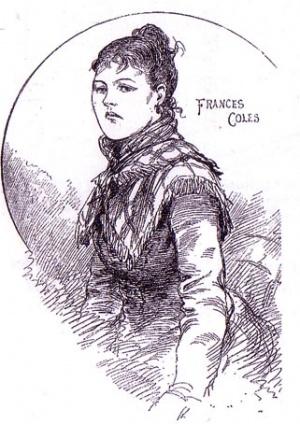
Perhaps the one true shining diamond in the rough of Victorian Whitechapel, Frances Coles is often heralded as the prettiest of all the Whitechapel murder victims. She was born at 18 Crucifix Lane in Bermondsey on September 17, 1859. Her father, James William Coles, was a bootmaker from Publow, Somerset. Her mother, Mary Ann Carney, was from Armagh, Ireland. Despite some published reports, much of Frances's early life was spent in poverty. Coles eventully moved his family to 8 White Lion Court in Bermondsey's Leather District. By 1880 Frances was living on her own and had a job 'stoppering bottles' for a wholesale chemist shop in the Minories. She often complained to her older sister Mary Ann that the work was painful to her knuckles, and she apparently quit the job after some time.
No one knows when Frances first became involved with prostitution, but James Murray, a former client, told the police in 1891 that she had been working the areas of Whitechapel, Shoreditch, and Bow for eight years.
Regardless of the circumstances, her fall from grace was a secret she did her best to keep from her family. Her sister Mary Ann had had her over for tea on Boxing Day, 1890, and Frances claimed she was living with an elderly woman in Richard Street, Commercial Road, still working at the chemist's in the Minories. Mary Ann sensed something was awry, and noticed that her sister 'was very poor, and looked very dirty.' Mary Ann also thought she could detect the faint odor of alcohol on her breath on many occasions.
In 1891, her father James was quite advanced in his years, and was an inmate of the Bermondsey Workhouse, Tanner Street. Still, despite her circumstances, Frances made every attempt to visit her father and even attended church services with him on Sundays. The last time he saw Frances was on Friday, February 6, only a week before her death. She apparently revealed the fact that she had left her position at the chemist's, but she still contended that she was living in Richard Street. It wasn't until his daughter's death that Mr. Coles finally discovered the truth about Frances's situation, and a man named James Sadler.
A fifty-three year old merchant seaman and fireman on the S.S. Fez, Sadler was discharged on February 11 and proceeded to make his way toward Commercial Street and the Princess Alice pub. While having some drinks he met Frances, of whom he had been a former client, and the two decided to spend the night together. They did so at Spitalfields Chambers, a common lodging house at 8 White's Row, Spitalfields, and both spent the rest of the next day barhopping across the area.
February 12-13, 1891:
7:30 PM: Sometime around 7:30, Frances went to a millinery shop at 25 Nottingham Street, Bethnal Green, and purchased a new black crêpe hat with the 2s. 6d. Sadler had given her some hours before. Peter Hawkes, the man who sold the hat to Frances, later commented to police that she was "three sheets in the wind," a condition undoubtedly due to her day spent in the many pubs of the area.
9:00 PM - 11:00 PM: At some point in this interval, Coles and Sadler had an argument and both went their separate ways. Sadler claimed he was robbed in Thrawl Street: "I was then penniless," he said, "and I had a row with Frances for I thought she might have helped me when I was down." Although Sadler would not admit to the fact, it was later ascertained that he was attacked from behind by a woman in a red shawl. Her two male accomplices robbed him of his watch and money.
11:30 PM: Frances is drunk when returns to their lodgings at Spitalfields Chambers. She sits at a bench in the kitchen, rests her head on her arms, and quickly falls asleep. Sadler soon returns, face bloodied and bruised, and in a belligerent mood. "I have been robbed," he says, "and if I knew who had done it I would do for them." Charles Guiver, the night watchman at the lodging house, helped Sadler wash up in the back yard but was forced to ask him to leave as he hadn't the money for a room.
12:00 AM: James Sadler leaves the Spitalfields Chambers. Frances remains on the bench at the table, fast asleep.
12:30 AM: Frances wakes up, according to lodger Samuel Harris, and leaves White's Row since she also lacks her doss money. According to watchman Guiver, however, Frances wasn't to leave until around 1:30 or 1:45 AM.
1:30 AM: Joseph Haswell, an employee in Shuttleworth's eating house in Wentworth Street, is asked by Frances Coles for three halfpenceworth of mutton and some bread. She eats her meal alone in the corner, remaining there for some fifteen minutes. Hassell asks her to leave three times, but Frances refuses, telling Haswell, 'Mind your own business!" She finally leaves about 1:45 AM and headed toward the direction of Brick Lane through Commercial Street.
1:45 AM: Frances bumps into fellow prostitute Ellen Callana on Commercial Street. Soon afterward "a violent man in a cheesecutter hat" approaches Calana and solicites her. Calana decides to refuse his offer. The man punches her in the face, giving her a black eye, then walks over to Frances. Ignoring Calana's adice, Frances walks away with the stranger, headed in the direction of the Minories.
1:50 AM: James Sadler gets into his third brawl of the night with some dockworkers at St. Katharine Dock as he tries to force his way back onto the S.S. Fez, from which he had been discharged two days before. He is left bleeding from a rather sizable wound in the scalp after calling his attackers "dock rats." He then makes two attempts to enter a lodging house in East Smithfield, but was refused.
2:00 AM: Sadler is seen drunken and bloodied on the pavement outside the Mint by a Sergeant Edwards. He was 'decidedly drunk' at the time.
2:00 AM - 2:12 AM: Carmen William Friday (also known as 'Jumbo') and two brothers named Knapton walked through Swallow Gardens, a railway arch. They saw nothing out of the ordinary, only a man and a woman at the Royal Mint Street corner of Swallow Gardens. One of the Knapton brothers shouted "Good night" to the couple but received no response. 'Jumbo' Friday was later to say that the man looked like a ship's fireman, and that the woman was wearing a round bonnet.
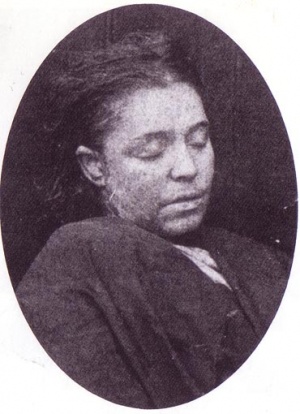
2:15 AM: P.C. Ernest Thompson 240H was on his beat along Chamber Street, only minutes away from Leman Street Police Station. He had been on the police force less than two months, and this was his first night on the beat alone. Thomspon heard the retreating footsteps of a man in the distance, apparently heading toward Mansell Street. Only a few seconds later he turns his vision to the darkest corner of Swallow Gardens and shines his lamp upon the body of Frances Coles. Blood was flowing profusely from her throat, and to Thompson's horror, he saw her open and shut one eye. Since the then unidentified woman was still alive, police procedure dictated that Thompson remain with the body -- his inability to follow the retreating footsteps of the man he believed to have been her killer (and possibly the Ripper) would haunt him for the rest of his days. Thompson was later stabbed to death in 1900 when trying to clear a brawl at a coffeehouse by a man named Barnett Abrahams.
2:25 AM: PC Frederick Hyde 161H was the first to come to Thompson's assistance, followed by plain-clothesman George Elliott (Warrant No. 65447). They found a local doctor, Dr. Frederick Oxley and rushed him to the scene. Chief Inspectors Donald Swanson and Henry Moore would later arrive around 5:00 AM, with Robert Anderson and Melville Macnaghten following later that morning.
3:00 AM: Sadler returns to the lodging house at 8 White's Row, heavily bloodstained from being robbed in Ratcliff Highway. The deputy, Sarah Fleming, turned him out, noticing he was so drunk he could barely stand or speak. He protested. "You are a very hard-hearted woman. I have been robbed of my money, of my tackle and half a chain."
5:00 AM: Sadler's injuries from his many fights the previous night finally catch up to him and he admits himself into the London Hospital for brief treatment.
10:15 AM: Duncan Campbell, a seaman at the Sailor's Home in Wells Street, allegedly purchases a knife from Sadler for the price of a shilling and a piece of tobacco. The knife is blunt. In fact, Thomas Robinson, a marine stores dealer who later purchased the knife from Campbell, testified that the knife was so blunt that he had to sharpen it before he could use it at dinner.
The circumstances of the death of Frances Coles appear to have been as follows:
She was first thrown down violently to the ground; revealed by a few wounds on the back of the head. Her throat was cut, most likely (according to Dr. Phillips, who performed the autopsy and Dr. Oxley, the first doctor at the scene while she was lying on the pavement. Phillips believed the killer held her head back by the chin with his left hand, cutting the throat with his right. The knife passed the throat three times -- first from left to right, then from right to left, and once more from left to right (Phillips). Oxley believed there were two wounds, since there was only one incision in the skin but two openings in the larynx. The killer struck from the right side of the body (Phillips) or from the front (Oxley). The body was tilted at the moment the wound was inflicted in a manner so that the killer would avoid becoming bloodstained. Her clothes were in order, and there were no abdominal mutilations. The killer exhibited no anatomical skill (Phillips). Part of her left ear had been torn off, but it was thoroughly healed as if as a result of an earring being ripped from her ear some time previously. The black crêpe hat she had purchased the night before was lying beside her, her old hat pinned beneath her dress. 2s were later found hidden behind a gutterpipe, presumably Frances's earnings from her final client.
Sadler was the immediate suspect of the police, thanks in no small part to the testimony of witnesses such as "Jumbo" Friday and Duncan Campbell. The police quickly rejoiced at the capture of the man they believed to be the murderer, and they were quick to wonder whether or not Sadler was indeed Jack the Ripper. Sadler was charged with the murder of Frances Coles on February 16.
Luckily for Sadler, the Seamen's Union paid for his proper legal representation, and perhaps even luckier, the inquest into Coles's death was headed by the very thorough Coroner Wynne E. Baxter. It was soon found that the couple "Jumbo" Friday had seen near Swallow Gardens was in fact two friends of his named Kate McCarthy and Thomas Fowles. And although the knife which killed Frances Coles was believed to have been blunt (like the one Sadler sold Campbell), the witness testimony of Sergeant Edwards and Sarah Fleming, who had seen Sadler hopelessly intoxicated at 2:00 and 3:00 AM respectively, made it unlikely that Sadler was capable of committing the murder. As Dr. Oxley testified, "If a man were incapably drunk and the knife blunt I don't think he could have produced the wound... If a man were swaying about I don't think he could control the muscles of his hand and arm sufficiently to cause the wound."
The jury returned a verdict of "Willful Murder against some person or persons unknown" on February 27, and four days later the Thames Magistrate's Court dropped all charges against Sadler. As he left the court, crowds of people cheered his release.
Many people at Scotland Yard, and even Sir Melville Macnaghten continued to press the belief that Sadler was guilty of the murder of Frances Coles, and the sides are split among contemporary researchers whether or not Sadler was the killer.
Was Frances Coles a Ripper victim? Her throat was cut, but unlike the canonical Ripper slayings, it was with a blunt knife. There seemed to have been no evidence of strangulation. There were no mutilations on the abdomen, and the clothes were not disarranged. Even more damning is the time frame of the murder -- almost two and a half years after the murder of Mary Kelly. Would the Ripper have stopped for such a long period of time and then resume his slayings with Frances Coles?
Still, the murder remained unsolved. She did die from a slit throat. She was an unfortunate. She was said to have been attacked from the right side (Phillips). And robbery was not a motive, as her earnings were found close by behind a lamp-post. The similarities are there.
