Whitechapel
From: "The Copartnership Herald", Vol. III, no. 34 (December 1933)
The present parish
of Whitechapel was constituted for civil purposes in 1895
by an Order, confirmed by the Local Government Board,
whereby it was provided, among other adjustments of
boundaries, that the parish of Holy Trinity, Minories,
should be united to it. Otherwise the parish represents
what was once known as the Upper Hamlet of Whitechapel,
the Lower Hamlet having been included in the parish of
St. John Wapping when it was created by an Act of
Parliament in 1694.
The parish of St. Mary of
Matfellon was formed out of the large ecclesiastical
district of Stepney in the beginning of the fourteenth
century. The name, which has baffled so many attempts to
arrive at a satisfactory explanation of its meaning and
derivation, was that of the little chapel whose white
exterior made it a land mark on the way out of the City
beyond the parish of St. Botolph Without Aldgate, which
extended to Hog Lane, afterwards called Petticoat Lane,
and now renamed Middlesex Street. Here, too, is the
boundary of the City of London, one furlong east of
Aldgate - the situation of the gate itself. Two furlongs
further eastwards stood the little edifice that
subsequently gave to the locality, at least from 1840,
its name of Whitechapel. The creation of the parish could
not have been on account of the needs of a numerous
population, for in so early a period few persons, if any,
would have chosen to live outside the protection of the
City, and as feudal conditions still prevailed those who
were obliged to do so were bound by service to the manor.
The arrangement made between the Rector of Stepney and
the Bishop of London, who was also Lord of the Manor,
could only have been for the allocation of the tithes of
a defined district, especially one, too, which comprised
corn-yielding land. In a document drawn up in 1323
reference is made to twelve acres of arable land in the
parish of St. Mary Matfallon.
There is some reason to suppose that the original
parish did not extend eastwards of the church, and that
more than two centuries had passed before it brought
within it the ribbon strips on both sides of the highway
so far as Mile End. Until wheeled transport made some
sort of a road necessary, the way out of London was
nothing but a rough track. Perhaps Nicholas Dereman had
bad recollections concerning it when in 1335 he
bequeathed "to mend the way where most needful from
the Church of St. Mary de Matfolone toward Myle End 100
shillings and his olden white horse on which he was wont
to ride."
The rural features of Whitechapel underwent little
change until Elizabethan times. For the first time, then,
the citizens began to extend the bounds of their
habitations, to build and live outside the city. Among
the several mansions that were built there was one on the
west side of Petticoat Lane (as it had become to be
called) in which Count Gondomar, the Spanish Ambassador,
afterwards lived in the reign of James I. On the south
side of "the great street" butchers had already
established themselves, but opposite were houses with
orchards and gardens. "Over towards Shoreditch open
country with rows of elm trees, and easy stiles to pass
over the pleasant fields, for citizens therein to walk,
shoot and otherwise recreate and refresh their dull
spirits in the sweet and wholesome air" (Strype).
When he lodged at St. Helen's, Bishopsgate,
Shakespeare may have walked across these fields from the
Curtain Theatre to the Tower, to linger there as a
country-bred man would, or to the busy quay at St.
Katherine's, there to observe the little trading vessels
and note the manners of the sailors. Ben Jonson was
certainly well acquainted with the neighbourhood. He
says:-
"We will survey the suburbs, and make forth
sallies
Down Petticoat Lane and up the Smock-Alleys
To Shoreditch, Whitechapel, and so to St. Katherine's
To drink with the Dutch there."
At the close of the century a great change began to
take place. John Stow, the tailor's son who devoted his
life to enrich our knowledge and was reduced to begging
as a reward, tells us that "...without the bars (the
City boundary) both sides of the street be pestered with
cottages and alleys even up to Whitechapel Church and
almost half a mile beyond it, into the common field (Mile
End Green); all of which ought to be open and free to all
men. But this common field, I say, being sometime the
beauty of this city on that part, is so encroached upon
by building of filthy cottages that in some places it
scarce remaineth a sufficient highway for the meeting of
carriages and droves of cattle. Much less is there any
fair, pleasant, or wholesome way for people to walk on
foot, which is no small blemish to so famous a city to
have so unsavoury and unseemly an entrance to it."
South of the highway is a district which for many
years retained its old name of Goodman's Fields. Before
the dissolution of the monasteries it adjoined the
property belonging to the nuns of the Order of St. Clare
who were called Minoresses, a name which is perpetuated
in the street Minories. Stow, who was born in 1525 in the
parish of St. Michael's, Cornhill, and writing in 1599,
gives the following pleasing pastoral and economic
reference.
"Near adjoining to this abbey, on the south side
thereof, was sometime a farm belonging to the said
nunnery; at the which farm I myself in my youth have
fetched many a halfpenny worth of milk, and never had
less than three ale pints for a halfpenny in the summer,
nor less than one ale quart for a halfpenny in the
winter, always hot from the kine, as the same was milked
and strained. One Trolop, and afterwards Goodman, were
farmers there, and had thirty or forty kine to the pail.
Goodman's son being heir to his father's purchase, let
out the ground first for the grazing of horses, and then
for garden-plots, and lived like a gentleman
thereby."
The introduction of coaches and the general hire of
them by the public had its effect in the seventeenth
century in the inns of Whitechapel and on the highway
itself. Rich visitors who came to London employed them,
and owing to the rough-paved and narrow streets left them
in the yards outside Aldgate. The luxury of coach riding
appealed to the pride of all classes - much in the same
way as motor cars do to-day. Taylor, the Water Poet, in
his World Runs on Wheels tells of "two
leash of oyster-wives" who "hired a coach to
carry them to the green-goose fair at Stratford-the-Bow;
and as they hurried betwixt Aldgate and Mile-end, they
were so be-madam'd and be-mistress'd and ladyfied by the
beggars that the foolish women began to swell with a
proud supposition of imaginary greatness, and gave all
their money to the mendicanting canters." With the
drovers of cattle, market folk, and the populace
generally coaches were "hell-carts." It is
affirmed that in 1636 the coaches "in London, the
suburbs, and within four miles compass without are
reckoned to the number of six thousand odd."
 When
the Civil war broke out, among the City fortifications
raised by Common Council and Parliament was one that was
erected in 1642 - near the windmill that stood in
Whitechapel. This mill was a short distance eastwards of
the church close to the beginning of the fieldpath then
leading to Stepney church that is now Fieldgate Street.
When
the Civil war broke out, among the City fortifications
raised by Common Council and Parliament was one that was
erected in 1642 - near the windmill that stood in
Whitechapel. This mill was a short distance eastwards of
the church close to the beginning of the fieldpath then
leading to Stepney church that is now Fieldgate Street.
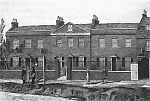
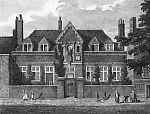
In 1673 the old church which had been built since
1362, after a former one had been destroyed by a tempest,
was pulled down excepting for the tower on account of it
being in a dilapidated state. A new edifice was erected
through the generosity of William Meggs, who also built
and endowed almshouses at the "Town's End" for
twelve poor inhabitants of the Upper Hamlet. The
almshouses were situated on the south side of Whitechapel
Road, and subsequently enlarged. The site and buildings
thereon were purchased in 1883 by the East London Railway
Company, and where they stood may be indicated by the
position of St. Mary's Railway Station. The rector was
the Rev. Ralph Davenant, who died in 1680 and bequeathed
a legacy for the education of forty boys and thirty girls
of the parish in "reading, writing and the casting
of accounts," which has grown into the present
Davenant Schools.
 It
was probably at this period that the parish boundaries
were revised and were extended along the Essex highway
nearly as far as Mile-end. A few yards short of that spot
a stone bridge crossed a sewer which went from
Spitalfields and entered the Thames at Penny Fields in
Poplar, and marked the actual "Town's End."
North of the road was Whitechapel Green, with a
ducking-pond - a watering-place for the cure of scolds,
shrewish wives, drunkards, and other obnoxious persons.
It
was probably at this period that the parish boundaries
were revised and were extended along the Essex highway
nearly as far as Mile-end. A few yards short of that spot
a stone bridge crossed a sewer which went from
Spitalfields and entered the Thames at Penny Fields in
Poplar, and marked the actual "Town's End."
North of the road was Whitechapel Green, with a
ducking-pond - a watering-place for the cure of scolds,
shrewish wives, drunkards, and other obnoxious persons.
For many years there was in this vicinity a
rectangular piece of ground which, although territorially
appearing to be in Whitechapel, is shown on certain maps
as being in Stepney, but detached therefrom. It marks the
place where once stood a Court of Record to which was
attached a prison for debtors in respect of sums of £5
and under in the manor of Stepney. A melancholy tale of
this prison could be told, of how often paltry debts
would by costs become so magnified that the debtors could
only secure their release by the intervention of some
unprincipled persons who would go bail for them, thus
securing a hold over them. These extortioners would then
employ their victims in the skilled trades to which they
belonged at a barest subsistence wage, under the threat
of withdrawing their protection. To swear a debt against
a person and so get him or her into the place was almost
a substitute for murder. In 1630 there were eighteen
debtors' gaols in or within a mile of London. A poet,
speaking of two of these says:-
"Lord Wentworths Jayle within White Chapell
stands,
And Finsbury: God bless me from their hands."
The Praise and Virtue of a Jayle
and Jaylers, 1630
by Sydney Maddocks
Reprinted with permission of David Rich, Tower Hamlets History On Line.
