Spitalfields (Part I)
From: "The Copartnership Herald", Vol. I, no. 10 (December 1931)
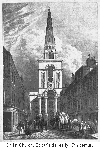 With the exception of its inhabitants and
of those who have business there to attract them,
Spitalfields is but little known even to a large number
of the population of East London, whose acquaintance with
it is often confined only to an occasional journey in a
tramcar along Commercial Street, the corridor leading
from Whitechapel to Shoreditch. By them the choice of the
site of the church, as well as that of the market, may
very easily be attributed to the importance of the
thoroughfare in which they are both now found; but such
is not the case, for until the middle of the last century
Commercial Street had not been cut through the district.
The principal approach to Spitalfields had previously
been from Norton Folgate by Union Street, which, after a
widening, was referred to in 1808 as "a very
excellent modern improvement." About fifty years ago
this street was renamed Brushfield Street, after Mr.
Richard Brushfield, a gentleman prominent in the conduct
of local affairs.
With the exception of its inhabitants and
of those who have business there to attract them,
Spitalfields is but little known even to a large number
of the population of East London, whose acquaintance with
it is often confined only to an occasional journey in a
tramcar along Commercial Street, the corridor leading
from Whitechapel to Shoreditch. By them the choice of the
site of the church, as well as that of the market, may
very easily be attributed to the importance of the
thoroughfare in which they are both now found; but such
is not the case, for until the middle of the last century
Commercial Street had not been cut through the district.
The principal approach to Spitalfields had previously
been from Norton Folgate by Union Street, which, after a
widening, was referred to in 1808 as "a very
excellent modern improvement." About fifty years ago
this street was renamed Brushfield Street, after Mr.
Richard Brushfield, a gentleman prominent in the conduct
of local affairs.
The neighbourhood has undergone many
changes during the last few years owing to rebuilding and
to the extension of the market, but the modern aspect of
the locality is not, on this occasion, under review, for
the references which here follow concern its past, and
relate to the manner of its early constitution.
In 1728 the parish of Christ Church, Middlesex (to
give the legal appellation), was formed out of a portion
of the old parish of Stepney. The vicinity, however,
continued to be called by the name established by long
usage, and which originally had been bestowed on a small
area included in it, that is to say, the fields which
once had been at the back of and adjoining the Priory of
St. Mary Spital. This priory was founded by William
Brune, a citizen of London, and his wife Rosia, in the
year 1197 on the highway outside Bishopgate in the parish
of St. Botolph. Although its lands had extended
northwards to the boundary of the parish of Shoreditch,
the site of the Spital was between what is now Spital
Square and White Lion Street, where until recently there
could be seen built in the first house on the north side
a stone jamb marking where once stood an ancient gate.
This religious house, in the course of the years that
followed its foundation, received many benefactions from
the citizens of London, and at its dissolution in 1534,
when its property was surrendered to King Henry VIII,
there is evidence that its revenues had been at least
partially appropriated to good uses, for, according to
the historian John Stow "besides ornaments of the
church and pertaining to the hospital, there was found
standing one hundred and eighty beds well furnished for
the poor, for it was an hospital of great relief."
The date when the Priory and Spital - described as
strongly built of timber with a turret at one corner -
was demolished is not known, but sixty years after its
dissolution, in 1594, the site was occupied by "many
fair houses, builded for the receipt and lodging of
worshipful and honourable men" (Stow)
On the east side of the churchyard of the Hospital
(now Spital Square) there was a large field formerly
called Lollesworth, and later Spital field, which came
into the possession of the Bishop of London in the
sixteenth century. It formed no part of the liberty of
Norton Folgate, which anciently belonged to St. Paul's
Cathedral, and which derived its name from the important
Foliot family, one of whom, Gilbert, was Bishop of London
from 1163 to 1186.
When the Spital field was broken up in 1576, for clay
to make bricks, an interesting discovery was made. Many
urns, coins, bones and vestiges of coffins were found,
indicating that it had been used as a place of burial by
the Romans. During the eighty years that followed the
discovery there was very little change in the appearance
of this and the adjoining fields, over which the archers
and men with the cross-bow practised in Tudor days, and
where then and long afterwards the citizens took their
walks to Bethnal Green and Mile End amid rural
surroundings.
In Cromwellian times here was the place of an
occasional fair such as that to which allusion is made in
the satirical verse of an anonymous writer who mocked the
differences in the prognostications of those astrologers
and mountebanks who:
"to try
In one poore day to vent their foolerie;
Whereupon resolved to constitute a faire
In Spittlefields, exposing each man's ware
To public view."
A change was soon about to take place. In 1657 an Act
was passed which contained a clause enabling
"William Wheler Esquire, who is by lease and
contract engaged to build certain houses in and upon
lands in Spitalfields in the parish of Stepney, at any
time before 1 October 1660 to erect, new build, and
finish, upon eight acres of the said fields, on part
whereof divers houses and edifices are already built and
streets and highways set out, several houses, and other
appurtenances." This marks the beginning of the
transformation of the district, for by 1660 the field was
covered with buildings, and the remembrance of the
occurrence is perpetuated in the name of Wheler Street.
Spital Square occupies the plot of ground on which
there once stood, at the north-east corner, a pulpit
cross, first found mentioned in 1398, from whence were
preached for many years the celebrated Spital sermons
during the Easter holidays. At these,the Lord Mayor,
Aldermen and Sheriffs always attended, robed in violet
gowns on Good Friday and Easter Wednesday, and on the
other days in scarlet. Near the south side of the pulpit
was a two-storeyed house, built in 1488 at the expense of
an Alderman, the first floor being for the accommodation
of the Lord Mayor and the second for the bishops who
might attend.
On such occasions persons of distinction became the
guests of the Lord Mayor for the rest of the day, and
were "lovingly and honourably both welcomed and
entertained with a most liberal and bountiful
dinner."
It is recorded by Hughson, the topographer of London,
that in 1559 Queen Elizabeth I came into the City from
St. Mary Spital "in state attended by 1000 men in
harness with sheets of mail, corslets, and morrice pikes,
and ten great pieces (cannon) drawn through the city, to
her palace; the cavalcade was attended with drums, flutes
and trumpets, two morrice dancers, and two white bears in
cart." This was in the mayoralty of Sir William
Hewett, and as probably was usual on such occasions, the
Queen in the first year of her reign, honoured the Spital
sermon with her presence.
The Spital sermons were here preached until the Pulpit
Cross was destroyed in the troublous days of Charles I.
From the Restoration to the year 1797 they were preached
at St. Bride's Church, and since that time at Christ
Church, Newgate Street.
Westwards of the Spital field there was an enclosed
piece of ground which had belonged to the dissolved
Priory, and which was called Tasel Close because teazles,
a prickly plant, were grown there for the cloth-workers
who used them in dressing their cloth. (A machine now
used to carry out this process is still called a teazle.)
Henry VIII granted this land to the Fraternity of the
Artillery for their exercise ground, and here they shot
at the popinjay with the cross-bow. The charter
incorporating the Fraternity granted by the King was
surrendered for a new one with larger powers given by
Queen Elizabeth in 1585 during the Spanish threat of
invasion. Here merchants and other citizens trained
themselves and others in the management of guns, pikes
and halberds, and to take command of the common soldiers.
When the City troops mustered at the camp at Tilbury in
1588 the captains were selected from the Artillery
Company and called Captains of the Artillery Garden.
"Well, I say, thrive brave Artillery Yard,
.....that has not spar'd
Powder or paper to bring up youth
Of London in the military truth."
-----Ben Jonson, Underwoods, xii.
The danger being past, the assemblies were neglected,
and the artillery ground, enclosed by a brick wall, was
reserved for the gunners of the Tower of London, who
"levelling certain pieces of great artillery against
a butt of earth made for that purpose, they discharged
them" (Strype). When the members of the Artillery
Company renewed their activities, and obtained the
permission of King James I, weekly use of the ground was
made by "divers worthy citizens, gentlemen and
captains using martial discipline...to their commendation
in so worthy an exercise."
About 1640 the Artillery Company, having greatly
increased in number, removed from Spitalfields to
Finsbury, and the two artillery grounds, the
"Old" and the "New," were
respectively so distinguished.
The use of the old Ground was continued by the London
Trained Bands, and it was the place where the
Parliamentarians enlisted their first soldiers against
the King. Clarendon, referring to the battle of Newbury,
wrote that "the London Trained Bands and auxiliary
regiments, of whose inexperience of danger, or any kind
of service beyond the easy practice of their postures in
the Artillery Gardens, held till then too cheap in
estimation, behaved themselves to wonder, and were in
truth the preservation of the army that day."
Samuel Pepys recorded a visit to Spitalfields:
"20 April 1669. In the afternoon we walked to
the Old Artillery Ground near the Spitalfields, where
I never was before, but now by Captain Deane's
invitation did go to see his new gun tryed, this
place being the place where the officers of the
Ordnance do try all their great guns."
In consequence of the Old Artillery Ground being
subject to the Tower, it became one of its liberties,
and, with the adjoining liberty of Norton Folgate, it was
included among the Tower Hamlets, and ultimately the
former liberty and part of the latter were incorporated
in the Borough of Stepney.
by Sydney Maddocks
Next in series: Spitalfields (Part II)
Reprinted with permission of David Rich, Tower Hamlets History On Line.
