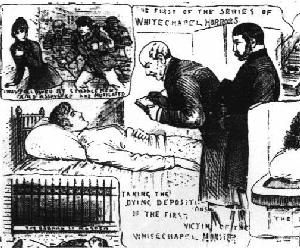
Contemporary report on the murder of Emma Smith.
Born c.1843
Although forty-five years of age, a mother or two, a widower and a prostitute, Emma Smith is generally looked upon as something of a mystery. Her acquaintances gave her a much higher standing than others of her kind would have received, and the events which were to lead to her death must still cause the casual reader to wonder at the absolute strength of this woman.
Emma claimed to have both a son and a daughter living somewhere in the area of Finsbury Park, and was often heard to say that they should do something to help her situation. She had been a prostitute for some time now, at least since she last saw her husband (she claimed to have been a widow, but also claimed she left her husband in 1877). Emma was also somewhat of a belligerent woman, often seen with a black eye and other various cuts and bruises as a result of many a drunken brawl.
She had been living at 18 George Street for about a year and a half, with a routine practically set in stone: she'd leave her lodgings between six and seven in the evening, practice her trade for the night, and return in the small hours of the next morning. And so it went on Bank Holiday night, Easter Monday (April 3, 1888) that she left around 6:00 PM searching for trade. She was next seen by Margaret Hayes at around 12:15 AM talking to a man dressed in dark clothes and a white scarf in Fairance Street, Limehouse. The next time she was seen was about four hours later, when she staggered into her lodgings at George Street, her face bloodied and her ear cut, with her woolen shoulder wrap pressed between her thighs to clog the injury which would later lead to her death.
As she would later report, she was returning home that night, probably the worse for drink, when at least three, maybe four youths began following her from Whitechapel Church. They would stop her on the corner of Brick Lane and Wentworth Street, where they beat, raped, and viciously jabbed a blunt object into her vagina, tearing the perineum. The boys emptied her purse before leaving her to die on the street. Here is where the story becomes incredible.
Having just been beaten and raped, and having sustained a sizeable (and no doubt excruciatingly painful) injury, Emma Smith stood up and walked back to her lodgings at 18 George Street. She had apparently removed her shoulder wrap and placed it between her thighs to soak up the blood which had undoubtedly been flowing from her ripped perineum. The lodging house deputy, Mary Russell and lodger Annie Lee, amazed that she could even have made it this far, rushed her to the London Hospital on Whitechapel Road, apparently against Emma's will. Once there she was seen by George Haslip, the house surgeon and she fought unconsciousness long enough to describe her assailants and the details of her assault. Finally, Emma could no longer stave off the severity of her injuries and succumbed to a coma, in which she would die four days later.
It is believed by most that it was one of the many Whitechapel gangs which killed Emma Smith, and not the Ripper. 'High rip' gangs were known to patrol the area in which the incident occurred, extorting money from prostitutes and other downtrodden women in return for their protection. In fact, it wasn't until September of 1888 that she was first attributed as a Ripper victim by the press.
Emma's death is also important in that many believe it may have been a contributing factor in the creation of the mythical "Fairy Fay" murder (if, indeed, it is taken to have been a mythical murder). Some authors note that "Fairy Fay" was said to have been killed by a stake jabbed into her abdomen -- much like Emma was killed by a blunt object stabbed into her vagina. Therefore, many claim, it was the means of Emma's murder combined with the date of Rose Mylett's death which led to the creation of the "Fairy Fay" murder.
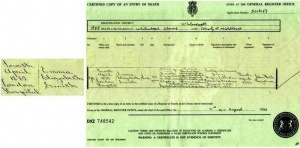
Death certificate of Emma Smith.
Whether or not Emma's death should be attributed to the Ripper is a question responded to in the negative by almost all Ripperologists. There is no reason to doubt her story that she was attacked by three (or four) men, and no other Ripper victim (except for the possibility of Stride, according to Israel Schwartz's account) was believed to have been killed by more than one man. Also, the fact that she was raped is not consistent with the other Ripper victims.
In fact, to accept Emma as a veritable victim, one must accept that the Ripper was either part of a group at one time, or even part of a gang. Unfortunately, there is little evidence to back this theory.
Emma Smith and "Fingers Freddy"
There is also a recently alleged theory concerning Emma Smith which involves a shady character known only as Fingers Freddy. In his writings for The Sun in 1972, Superintendant Arthur Butler described the story of Fingers Freddy, who he claimed was a street showman who would perform various magic tricks while accomplices would pick his spectators' pockets. It was also alleged that this man was Emma Smith's protector, and that the two knew Jill the Ripper (who, you will remember, was said to have lived somewhere in Brick Lane), and planned to blackmail her by threatening to expose her as an illegal abortionist (this probably assumes the fact that the two did not realize that this woman was in fact the Whitechapel fiend). Smith then turned up dead, and Freddy disappeared immediately after. It is unknown whether or not Freddy was also killed, as he may simply have fled the area knowing his life was in danger.
